ermahgerd provides organization-scoped durable queues with the familiar
Cloudflare Workers producer and consumer interfaces. Queues are managed through
Wrangler and the console; Worker code sends with env.QUEUE.send() and consumes
with an exported queue(batch, env, ctx) handler.
Create queues
Point Wrangler at the local API as described in Deploy Workers, then create the primary and dead-letter queues:
cd examples
npx wrangler queues create documents
npx wrangler queues create documents-dlq
Queue names are scoped to the authenticated organization. Two organizations may
both own a queue named documents; their registries, broker state, messages,
consumers, and DLQs remain distinct.
Queues do not have a public hostname. Their data plane is deliberately exposed
through scoped Worker bindings, while their management plane uses the authenticated
/accounts/<organization>/queues API.
Produce messages
Declare a producer binding in Wrangler configuration:
{
  "queues": {
    "producers": [{"binding": "DOCUMENTS", "queue": "documents"}]
  }
}
Then send from request or scheduled code:
await env.DOCUMENTS.send({id, document});The trusted runtime adapter captures the calling organization and queue name. Worker code cannot replace that scope or obtain the queue service credential. For diagnosis and manual workflows, a member with queue write access can also use Send message on the queue detail page to enqueue a validated JSON payload with an optional delivery delay. This uses the same durable broker path as a Worker binding.
Consume messages
Attach a Worker consumer through the same Wrangler project:
{
  "queues": {
    "consumers": [{
      "queue": "documents",
      "max_batch_size": 10,
      "max_batch_timeout": 2,
      "max_retries": 3,
      "retry_delay": 1,
      "dead_letter_queue": "documents-dlq"
    }]
  }
}
The Worker exports the native queue handler:
export default {
  async queue(batch, env) {
    for (const message of batch.messages) {
      await env.DOCUMENTS.put(`documents/${message.id}.json`,
        JSON.stringify(message.body));
      message.ack();
    }
  }
};
Wrangler creates or updates the consumer after uploading the Worker. Each delivery resolves the Worker’s current active version, so messages already waiting or retrying can be handled by a newly deployed revision without rewriting queue state.
Delivery, retries, and durability
The dedicated ermahgerd-queue.service hosts all queue registry and broker Durable
Objects. Messages are committed to Durable Object SQLite before send() resolves.
Alarms recover delivery after process restarts. Delivery is at least once: consumers
must make side effects idempotent.
Native ack(), retry(), ackAll(), and retryAll() results control settlement.
An unsuccessful handler retries the batch. When retry attempts are exhausted, the
broker moves the message to the configured queue in the same organization or drops it
when no DLQ is configured. Queue state is local to data-02 and is removed by
make destroy.
The console’s Queues section treats delivery health as a first-class tenant surface. The inventory calls out blocked delivery, large backlogs, and old messages. Each queue has live backlog and message-activity charts, oldest-message age, cumulative delivery/retry/DLQ totals, pending message inspection, consumer settings, and durable delivery events. The detail view refreshes every ten seconds and can be paused while investigating. It highlights five-minute and one-hour age thresholds, backlogs of 100 and 1,000 messages, sudden enqueue growth, recent dead letters, and messages waiting without a consumer.
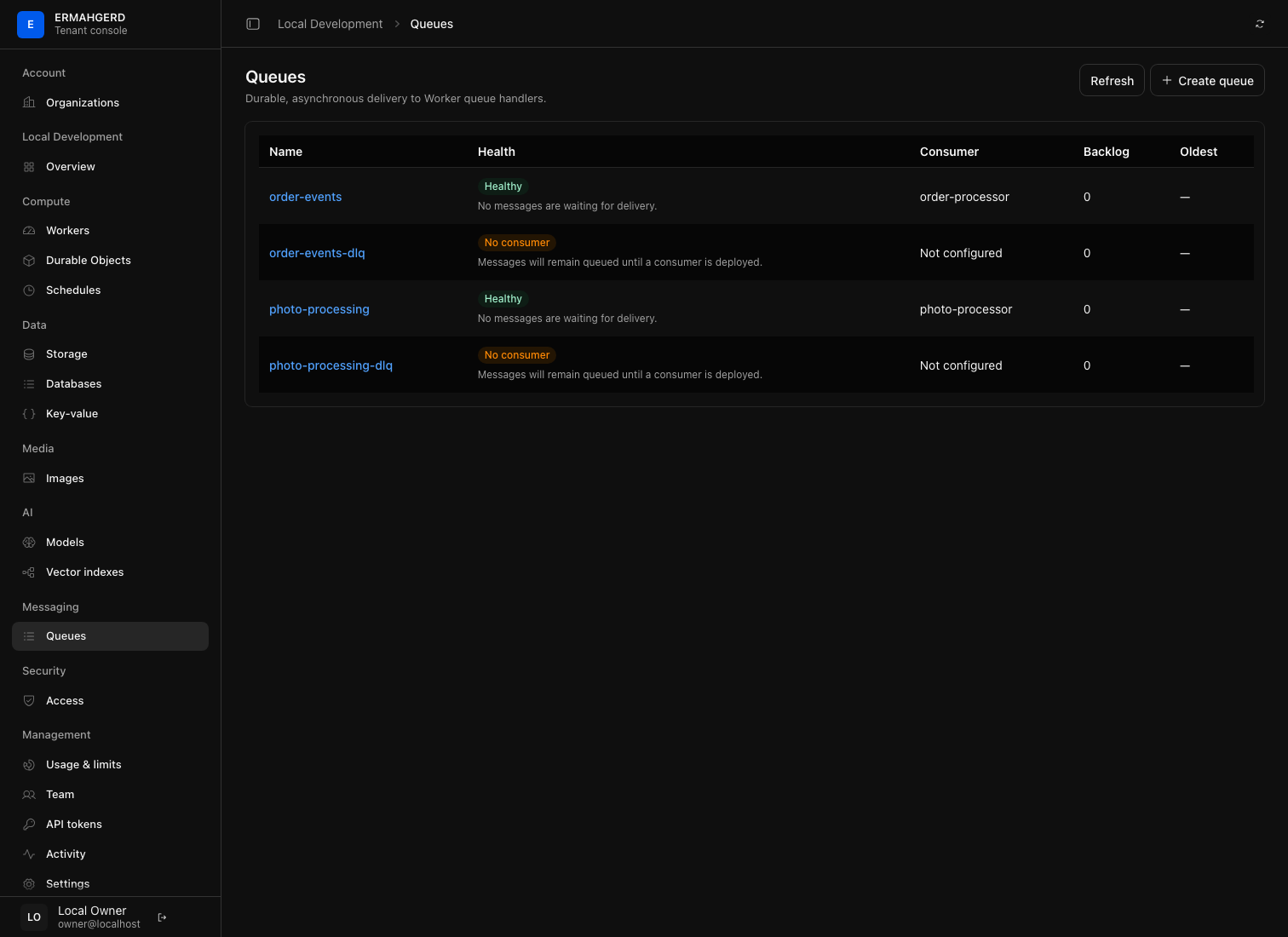
A DLQ is an ordinary queue and can be inspected there. Deletion is rejected while a queue contains messages; purging is a separate confirmed operation. Deleting an empty queue also removes its historical broker state, so recreating the name starts clean.
The queue service exports a continuous first-attempt scheduling SLI, backlog and oldest-message gauges, scheduling and handler histograms, and delivery outcome counters. The platform objective and its deliberately narrow ownership boundary are documented in Observability. Operators can use the provisioned service-level dashboard for error-budget burn, per-queue attainment, and saturation context; it remains an advanced operator surface rather than the tenant-facing queue interface.
End-to-end proof
The example under examples/queues-r2/ accepts a JSON document over HTTP, enqueues
it, and writes it to an R2 bucket from a background consumer. Run:
make queue-checkThe check deploys a deliberately failing consumer, observes a native retry, restarts the queue service to prove durable recovery, deploys a working consumer revision, verifies the existing message reaches R2, and finally verifies exhausted delivery in the dead-letter queue.
For continuity under sustained traffic and Worker updates, run
make load-services-update. It measures R2 round trips, durable enqueue latency,
consumer completion lag, and reconciles every accepted job while Wrangler deploys
three revisions. See the load-test guide
for thresholds, retained evidence, and test-resource names.